
Plenary Speakers
EOSAM will feature a distinguished lineup of plenary speakers from diverse fields of optics. We are proud to announce the following plenaries have been confirmed for EOSAM 2026:

Anne L'Huillier
Nobel Prize in Physics 2023, Lund University, Sweden
The Route to Attosecond Light Pulses
When an intense laser interacts with a gas of atoms, high-order harmonics are generated. In the time domain, this radiation forms a train of extremely short light pulses, of the order of 100 attoseconds. Attosecond pulses allow the study of the dynamics of electrons in atoms and molecules, using pump-probe techniques. This presentation will highlight some of the key steps of the field of attosecond science.
About the Speaker
Anne L'Huillier is a Swedish/French researcher in attosecond science. She started her career at the Commissariat à l'Énergie Atomique, in Saclay, France, as a PhD student until 1986, then as a permanent researcher until 1995. She was postdoc at Chalmers Institute of Technology, Gothenburg. Sweden in 1986, and at the University of Southern California, Los Angeles, USA in 1988, and a visiting scientist at the Lawrence Livermore National Laboratory in 1993. She moved to Lund University, Sweden, and became full professor there in 1997. Her research is focused on high-order harmonic generation in gases and its applications, particularly in attosecond science. She was awarded the Nobel Prize in Physics 2023 together with Pierre Agostini and Ferenc Krausz “for experimental methods that generate attosecond pulses of light for the study of electron dynamics in matter.
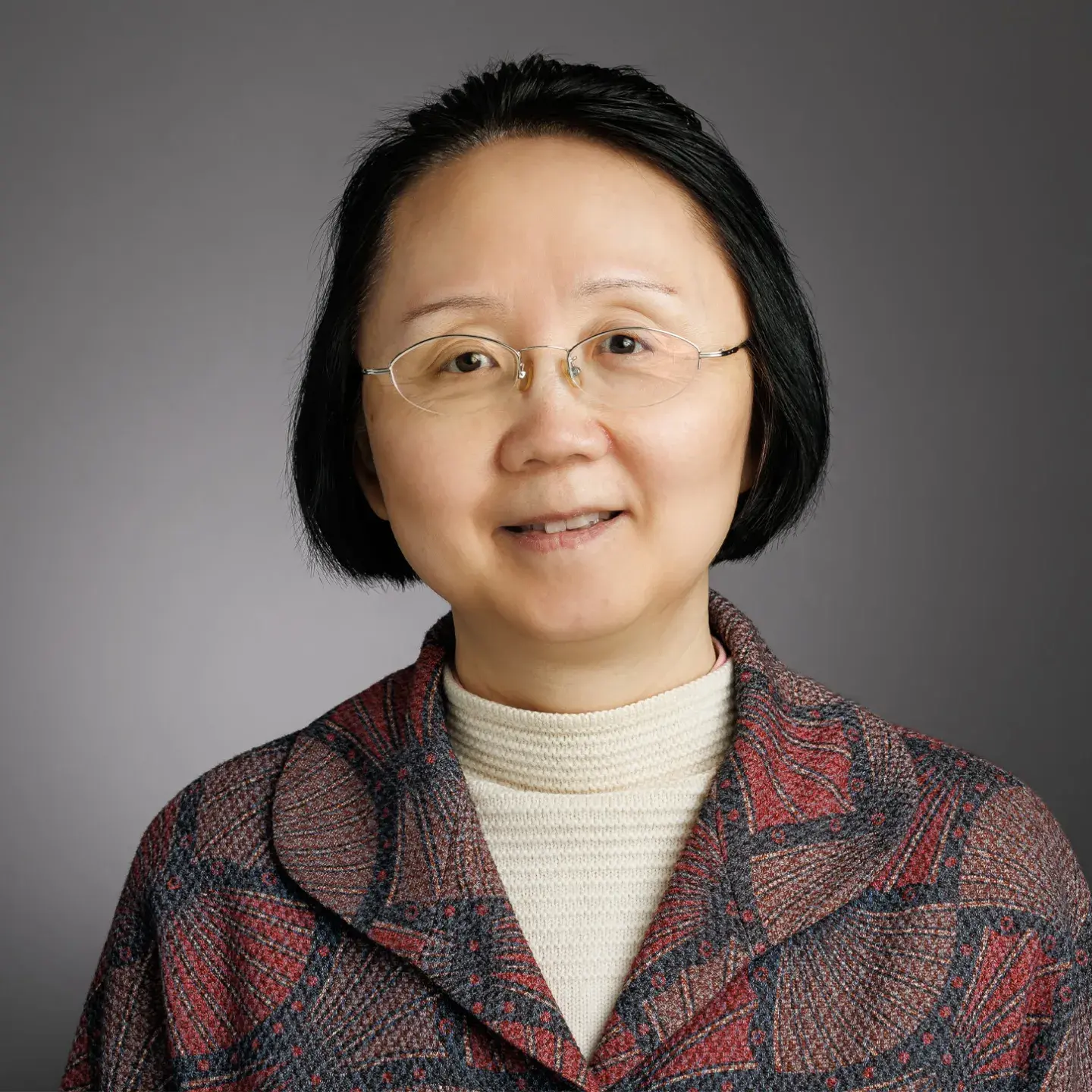
Hui Cao
Yale University, USA
High-power Single-Frequency Multimode Fiber Laser Amplifiers: A Paradigm Shift
High-power fiber lasers have become indispensable tools across science, advanced manufacturing, and defense. For decades, power scaling has relied on single- or few-mode fibers to preserve beam quality. However, the very tight optical confinement that enables diffraction-limited performance also enhances nonlinear effects, imposing fundamental limits on further power scaling.
In this talk, I will present a different approach: embracing highly multimode fiber amplifiers as a pathway toward mitigating nonlinearities while enabling substantially higher output power. While multimode fibers are traditionally associated with complex and unstable spatial dynamics, we demonstrate that this complexity can be harnessed rather than avoided. By applying spatial wavefront shaping to the input field, we achieve deterministic control over both the spatial profile and the polarization state of the amplified beam.
This strategy enables high-power, high-efficiency, narrow-linewidth operation in a highly multimode platform, challenging the conventional paradigm that beam quality and multimode propagation are incompatible. The results open new opportunities for scalable coherent beam combining, large-scale interferometry, and remote sensing, and suggest a new direction for the future of high-power fiber laser technology.
About the Speaker
Hui Cao is the John C. Malone Professor of Applied Physics, a Professor of Physics, and a Professor of Electrical Engineering at Yale University. She received her Ph.D. degree in Applied Physics from Stanford University in 1997. Prior to joining the Yale faculty in 2008, she served on the faculty of Northwestern University for a decade. Her research spans mesoscopic physics, complex photonic materials and devices, nanophotonics, and biophotonics, with an emphasis on light–matter interactions in complex and disordered systems. Cao is a Fellow of AAAS, IEEE, SPIE, APS and OSA. She is a member of the US National Academy of Sciences and the American Academy of Arts and Sciences, and a Fellow of the National Academy of Inventors.
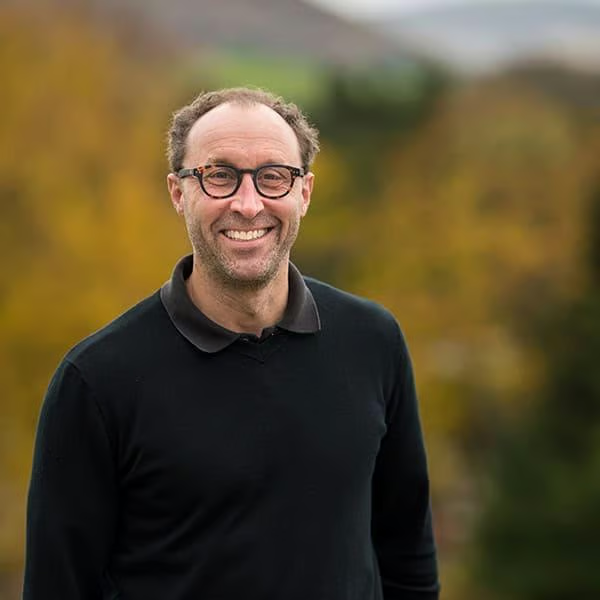
Daniele Faccio
University of Glasgow, UK
Functional Brain Imaging and Decoding with Time-Domain Photonics
Photonics currently stands out as the only viable technology for fully wearable, non-invasive sensing technology for the brain. We will discuss the current status of photonics for functional decoding of brain activity and examine the obstacles (opportunities) that are left to be solved on the route to light-based wearables that can read thought and intent from the human brain.
About the Speaker
Daniele Faccio is a Royal Academy Chair in Emerging Technologies, Fellow of the Royal Society of Edinburgh and Cavaliere dell’Ordine della Stella d’Italia (Knight of the Order of the Star of Italy). He joined the University of Glasgow in 2017 as Professor in Quantum Technologies where he leads the Extreme-Light group and is Director of Research for the School of Physics and Astronomy. He is also adjunct professor at the University of Arizona, Tucson (USA) and fellow of the Optical Society of America. Previously he was at Heriot-Watt University and University of Insubria (Italy). He has been visiting scientist at MIT (USA), Marie-Curie fellow at ICFO, Barcelona (Spain) and EU-ERC fellow 2012 (StG) and 2023 (AdG).
He started his research career working on optical telecomm devices before moving towards high-intensity laser physics, which eventually led to the study of optical analogues for black holes and gravity, optics in time-varying media and fundamentals of quantum mechanics. He currently focuses on computational imaging and sensing, quantum microscopy and the development of technology for functional diagnostics of the human heart and brain.
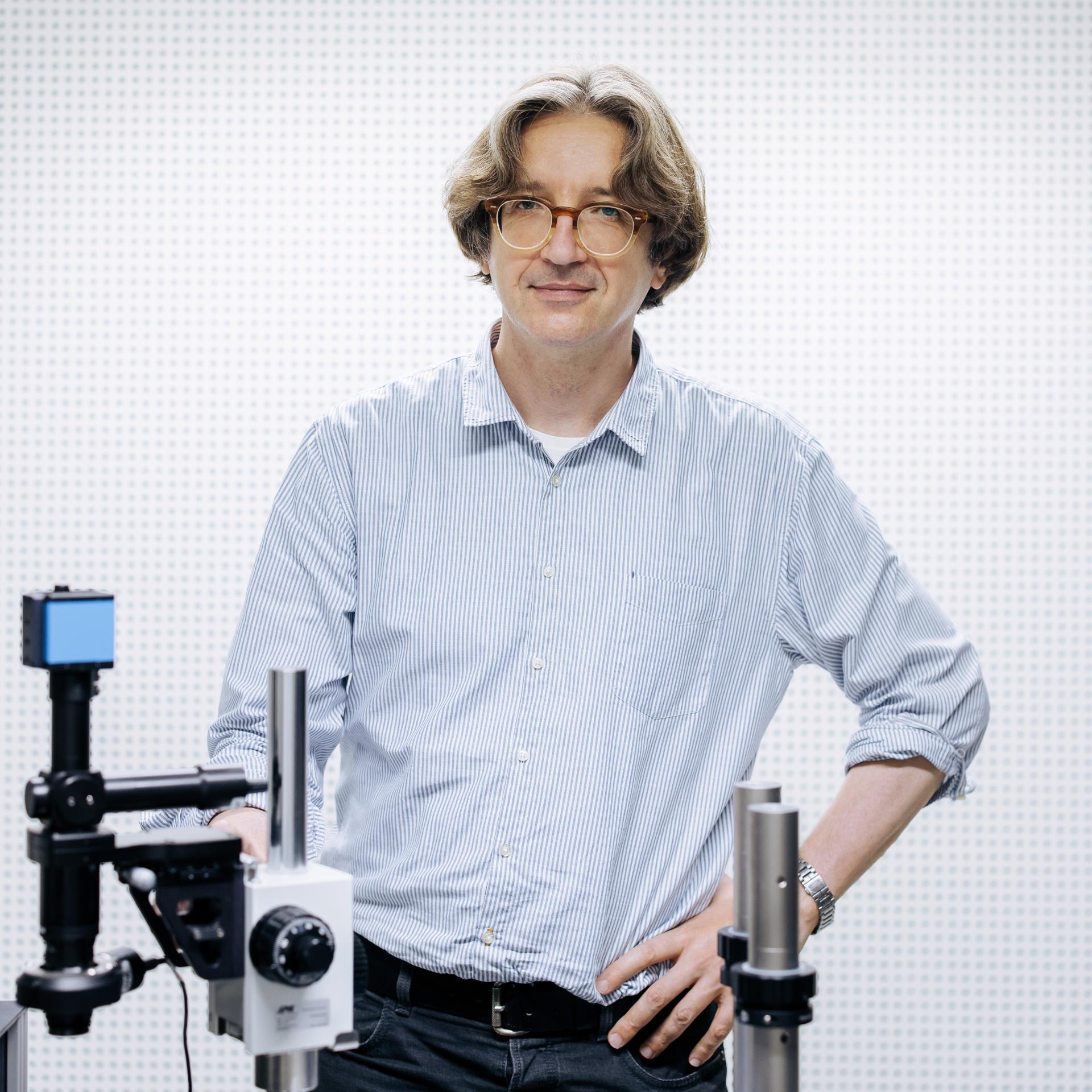
Fedor Jelezko
Ulm University, Germany
Quantum Biosensing Enabled by Diamond Spin Qubits
Colour centres in diamonds combine unique optical and spin properties, enabling their spin states to be detected and initialised efficiently. Due to their long coherence time, they can be used for sensing electric and magnetic fields. In this talk, I will present how nanoscale quantum sensors can be employed for NMR spectroscopy at the nanoscale. I will discuss multiparameter quantum sensing, combining the detection of free radicals and temperature sensing. The application of diamond nanoparticles for hyperpolarisation will also be presented.
About the Speaker
Fedor Jelezko is currently a director of the Institute of Quantum Optics at Ulm University, director of the Centre for Integrated Quantum Science and Technology and member of Heidelberg Academy of Sciences. He studied in Minsk (Belarus) and received his Ph.D. in 1998. After finishing the habilitation in 2010 at Stuttgart University he was appointed as a professor of experimental physics in Ulm in 2011. His research interests are at the intersection of fundamental quantum science and quantum technologies. His research team is exploring applications of spin qubits in diamond for information processing, communication, sensing, and imaging. Outside academia, he is involved in the development of quantum technologies based on spin qubits. Fedor Jelezko and his colleagues are now pursuing its exploitation by means of their start-up company NVision Imaging Technologies and Diatope.
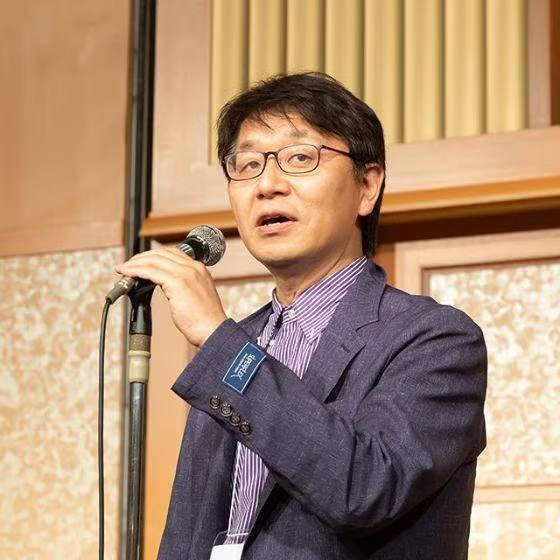
Donghyun Kim
Yonsei University, South Korea
EOS Partner Society, Optical Society of Korea (OSK), Presents:
Shaping Light at the Nanoscale: Metaplasmonic Structured Fields for Sensing, Imaging, and Beyond
Shaping light at the nanoscale offers new opportunities to interrogate, control, and ultimately engineer complex biological and physical systems. In this presentation, a metaplasmonic structured-light framework will be introduced, which unifies advances in nanophotonics, super-resolution imaging, and functional biosensing to enable quantitative access to dynamic processes beyond the diffraction limit. At the core of this approach is the concept of metaplasmonic structured fields—optical fields engineered through the interplay of surface plasmon and custom illumination. These fields provide enhanced light–matter interaction and spatial control, enabling both sensitive detection and high-resolution imaging within a single platform. Building on this principle, axial interference speckle illumination-engineered structured illumination microscopy (AXIS-SIM) will be presented, a robust and experimentally accessible method that achieves near-isotropic super-resolution without complex optical architectures. By leveraging simple back-reflection–induced interference, AXIS-SIM enhances axial confinement while maintaining resilience to misalignment and sample-induced aberrations. To demonstrate the power of this approach, its integration with microfluidic gut–brain-axis-on-a-chip systems is explored for probing exosome-mediated intercellular communication. This platform enables real-time, multiscale observation of exosome dynamics—from their release and guided transport to nanoscale uptake in living cells—bridging macroscopic transport phenomena and single-particle interactions under physiologically relevant conditions. Such capabilities provide new insight into the role of extracellular vesicles in complex signaling networks. Beyond this specific application, the presented approach establishes a general paradigm for metaplasmonic structured-light engineering, with implications spanning biosensing, live-cell imaging, and nanomedicine. By merging physical field design with biological functionality, it opens a pathway toward next-generation optical tools for diagnostics, therapeutic screening, and the exploration of emergent phenomena at the nanoscale.
About the Speaker
Donghyun Kim received his B.S. and M.S. degrees in Electrical Engineering from Seoul National University, Korea, and his Ph.D. from Massachusetts Institute of Technology, USA. After working as a Senior Research Scientist at Corning Incorporated and a postdoctoral researcher at Cornell University, he is currently a Professor at Yonsei University, where he leads the Biophotonics Engineering Laboratory.
He is a Fellow of SPIE and Optica, and currently serves as President of the Optical Society of Korea, where he advances international collaboration and strategic initiatives in photonics. He was the General Chair of CLEO Pacific Rim 2024 and has held leadership roles in numerous international conferences and scientific committees in optics and photonics. His research focuses on metaplasmonic field engineering, structured-light-enabled nanoscale bioimaging, and photonic technologies for biosensing and nanomedicine.
Polina Bayvel
University College London, United Kingdom
Optical networks: seeing through the nonlinear cloud in the AI world
It is 60 years since the publication of the paper by Kao and Hockham proposing optical fibres as the universal transmission medium. Optical fibre communication networks now form the web in WWW and underpin the digital communications and AI infrastructure, are essential to the cloud services. Since the first practical systems were introduced in 1970s, the transmission speeds have increased by over 6 orders of magnitude and the usable bandwidths in optical fibres approach 60THz in the ultrawideband regime and significantly beyond that in hollow-core fibres! In fact, we have come to reply on the ubiquitous, resilient, and high bandwidth anytime, anywhere. Can this continue? Optical network operate across multiple length and time scales, from trans-oceanic and long-haul transmission to metro, access and intra-/inter-data-centre connectivity. This talk will discuss how advances in optical fibres, ultrawideband transmission and wavelength-routed networking can be combined to create intelligent optical networks can evolve to adapt to changing demands and ensure low delay and resilience. What are the fundamental limits imposed by noise, optical fibre nonlinearities and can signal processing, network design and data-driven control help mitigate these, to develop a vision for future adaptive optical infrastructure in the AI world.
About the Speaker
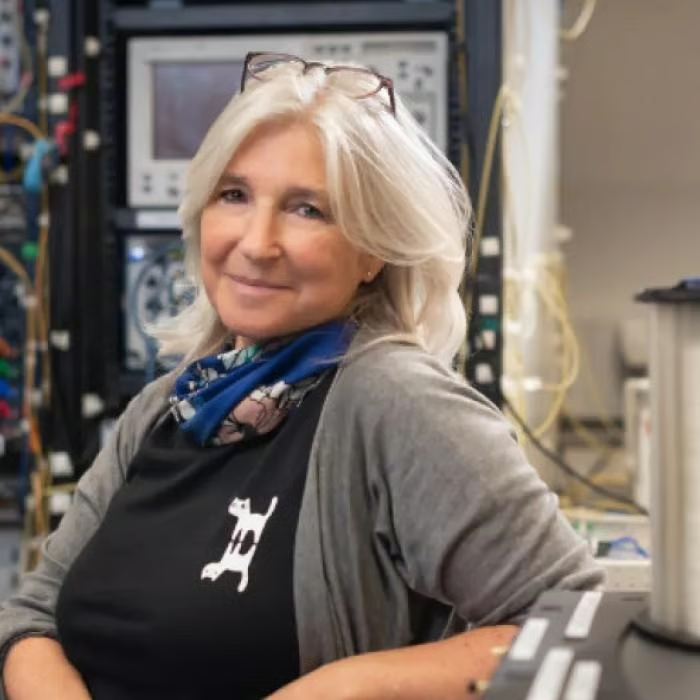
Professor Dame Polina Bayvel DBE FREng FRS is Royal Society Research Professor and Professor of Optical Communications and Networks at University College London, where she heads the Optical Networks Group (ONG). She found ONG as a Royal Society Unviersity Research Fellow in 1994, having come back to university following a period in industry designing submarine and landline optical networks at STC Submarine Systems and STL/Nortel (Harlow and Ottawa). Her research focuses on high-capacity optical fibre communication systems and networks, including multi-wavelength optical networking, optical transmission, and the fundamental capacity limits imposed by optical nonlinearities and their mitigation. Her work has contributed to the development of the optical communications infrastructure underpinning today’s Internet and digital communications infrastructure. She currently leads research on intelligent optical networks for future communications systems. She is a Fellow of the Royal Society, the Royal Academy of Engineering and IEEE, and received numerous awards including Humboldt Research Award, the Thomas Young and Rumford Medals (the first female recipient since their introduction in 1967 and 1800). She was appointed Dame Commander of the British Empire (DBE) in 2026 for services to engineering and optical communications.

Paloma Arroyo Huidobro
Universidad Autónoma de Madrid (UAM), Condensed Matter Physics Center (IFIMAC), Spain
Winner of the EOS Early Career Women in Photonics Award 2025
Light-matter Interactions in Time Varying Media
Time-varying metamaterials and nanophotonic systems offer a new pathway for controlling light. By engineering material properties not only in space but also in time, it becomes possible to access phenomena that have no counterpart in conventional static systems, including temporal reflections and refractions, nonreciprocal wave propagation, and new forms of wave amplification and energy exchange. In this talk, I will provide an overview of the foundations of time-varying photonics, highlight recent developments in time-modulated metamaterials and nanophotonic structures, and discuss opportunities for exploring light–matter interactions and wave control in these systems.
About the Speaker
Paloma Arroyo Huidobro is a Ramón y Cajal Research Fellow at the Universidad Autónoma de Madrid (Spain) and the Condensed Matter Physics Center (IFIMAC) since 2022. Prior to that, she was a Marie Curie Fellow at Imperial College London (UK) and an Associate Researcher and FCT Fellow at the Instituto de Telecomunicações in Lisbon (Portugal). Her research is focused in the study of light-matter interactions in nanophotonics and metamaterials and she currently leads a ERC Starting Grant devoted to time-varying nanophotonic media.
More information about the EOS Early Career Women in Photonics Award: EOS Early Career Women in Photonics Award