
Research Collaboration and Exchange in Optics and Photonics: Europe–Korea
Chairs
 |
Woonggyu Jung |
 |
Emiliano Descrovi Politecnico di Torino, European Optical Society (IT) |
Synopsis
The joint session between the European Optical Society (EOS) and the Optical Society of Korea (OSK) is intended to promote international cooperation and knowledge exchange between European and Korean researchers in optics and photonics. The session will bring together speakers from both regions with professional experience across these scientific communities, highlighting shared research achievements and collaborative opportunities.
The scientific exchange and dissemination of results will focus on key areas including Optical Metrology, Optical Materials, Biophotonics, and Nanophotonics.
Through this initiative, EOS and OSK aim to strengthen international partnerships, encourage collaborative research, and support the global advancement of cutting-edge optical science and technology.
About the European Optical Society (EOS)
The European Optical Society is a non-profit society, and an umbrella organization for all national optical societies around Europe. Their members extend from Europe to all over the world.
Their mission is to bring together and encourage the cooperation of all with an interest in optics, optoelectronics and related scientific fields, to make practical use of research results, and to support the industrial exploitation of optics. To this end, they organize international conferences, scientific, technical and cultural meetings, training courses, exhibitions, etc., and maintain relations with other societies and organizations, national or international, having similar interests.
The EOS has more than 4,000 societal, corporate, individual, associate and student members.
About the Optical Society of Korea (OSK)
The OSK was established in 1989 and has been a leading academic organization in the field of optics and related application technology in the Republic of Korea, with 10,000 current members and 9 specialized divisions. It was founded with the purpose of advancing optical technology and allied fields of science and engineering, both academically and technologically. The OSK publishes the domestic academic journal Korean Journal of Optics and Photonics, the SCIE-level international academic journal Current Optics and Photonics (COPP), and the optical magazine K-Light. The OSK also promotes communication and academic exchange among OSK members through annual conferences in summer and winter, with additional conferences that are specific to each research division. In addition, the OSK has been maintaining international exchanges with 18 optics-related societies overseas.
Invited Speakers

Sang-Won Lee
Korea Research Institute of Standards and Science
Utilization of Optical Coherence Tomography for Retina Study: From Realistic Phantoms to Preclinical Evaluation in Rodents and Marmosets
This presentation discusses the comprehensive utilization of Optical Coherence Tomography (OCT) in advanced retinal research, spanning from system calibration to preclinical evaluation. We introduce a 13-layered "Super Phantom" that replicates the human retina's characteristics, providing a reliable benchmark for multimodal imaging standardization. Furthermore, we demonstrate the platform’s utility through collaborative research with Seoul National University Hospital, where our high-resolution OCT system was employed to validate adenine base editing therapies in RS1-mutant mouse models. By capturing precise in-vivo images across diverse species, including marmosets, this study establishes a robust framework for consistent retinal assessment and highlights the versatility of our imaging platform in supporting cutting-edge therapeutic developments.
Sang-Won Lee, Ph.D., is a Principal Research Scientist and Group Head at the Nanobio Measurement Group, Korea Research Institute of Standards and Science (KRISS). He received his Ph.D. in the Dept. of Biomedical Engineering, Yonsei University and completed his postdoctoral fellowship at the Beckman Laser Institute & Medical Clinic, UC Irvine. With expertise in high-resolution OCT and optical metrology, his research focuses on establishing standardized imaging platforms for clinical and preclinical applications. He has pioneered the development of anatomically realistic "Super Phantoms" to enhance the reliability of multimodal ophthalmic diagnostics. Dr. Lee collaborates with clinical institutions to provide high-performance imaging solutions for various animal models—from rodent disease models to non-human primates—bridging the gap between engineering innovations and clinical translation.

Jae-Byum Chang
Korea Advanced Institute of Science & Technology
Super-resolution Imaging of Whole Vertebrate Bodies Using Expansion Microscopy
Since the invention of super-resolution microscopy, the field has advanced in three major directions: imaging larger specimens, detecting more molecular species, and achieving higher spatial resolution. Although technologies addressing these goals have largely been developed independently, emerging applications such as molecular connectomics increasingly require all three capabilities to be integrated within a single framework. In this talk, I will discuss our recent efforts to develop imaging technologies that meet these combined needs. First, I will introduce iterative expansion microscopy, which enables sub-20-nm resolution imaging across large specimens. Next, I will describe our work on multiplexed imaging, which allows visualization of more than 10–20 molecular targets in a single specimen. I will then present whole-body expansion microscopy, which enables super-resolution imaging across entire vertebrate bodies. Finally, I will discuss how these approaches can be combined, along with the technical challenges and potential solutions involved, including tissue distortion and ultra-high-precision image registration, AI-assisted strategies for increasing multiplexing capability within single staining and imaging rounds, and methods for accelerating expansion microscopy workflows.
Jae-Byum Chang is Associate Professor at the Korea Advanced Institute of Science and Technology, in the Department of Materials Science and Engineering Department of Biological Sciences. He is founder and CEO of the company Flashomics, Corp. He received his Ph.D. at the Department of Materials Science and Engineering from the Massachusetts Institute of Technology in 2014 entitled ‘Templated self-assembly for complex pattern fabrication’ under the supervision of Prof. Karl K. Berggren. He is an expert in on the development of advanced nanoscale imaging and nanofabrication techniques. His research overcomes optical limits using expansion microscopy to map whole embryos at nanoscale and enables ultra-multiplexed imaging without complex spectra. It also uses biological structures as precise templates for nanofabrication, bridging advanced visualization with nanoscale materials engineering.

Valery Filippov
Ampliconyx
High power Yb tapered double clad gain modules for industrial ultrafast fiber lasers
Preliminary results by accomplishing of KAIST funded joint project between Ampliconyx Oy (Finland), and Laserssel Ltd., Coset, and Chosun University (ROK), for development of high-power ultrafast picosecond industrial fiber laser for material processing are presented in the current contribution. Specifically, experimental results of testing a gain module comprising large mode filed area Yb doped tapered double clad fiber for CPA scheme are presented. The gain module delivering pulses with energy up to 0.38mJ, 2MW peak power and 7ps pulse durations in various configurations at 1040nm wavelength is demonstrated. The feasibility of creating CPA MOPA system with designed gain module is discussed.
Dr. Valery Filippov has received the Ph.D. degree in Radiophysics from Peter the Great St. Petersburg State Polytechnic University (St. Petersburg, Russia) in 1988. He has worked at Peter the Great St. Petersburg State Polytechnic University (1983-1998, St. Petersburg, Russia), Centro de Investigaciones en Optica (1998-2002, Leon, Mexico), University of Southampton (2002-2005, UK), Liekki Corp. (2005-2007 Lohja, Finland) and Optoelectronics Research Centre (Tampere University of Technology, 2007-2016). Since 2017 Dr. Filippov is founder and CEO of Ampliconyx Ltd. (Tampere, Finland), the start up company from Tampere University of Technology. Dr. Filippov has published more than 200 peer-reviewed journal articles; he is author of eleven patents. The main field of scientific interests includes optical fibers, fiber sensors and fiber lasers and amplifiers.
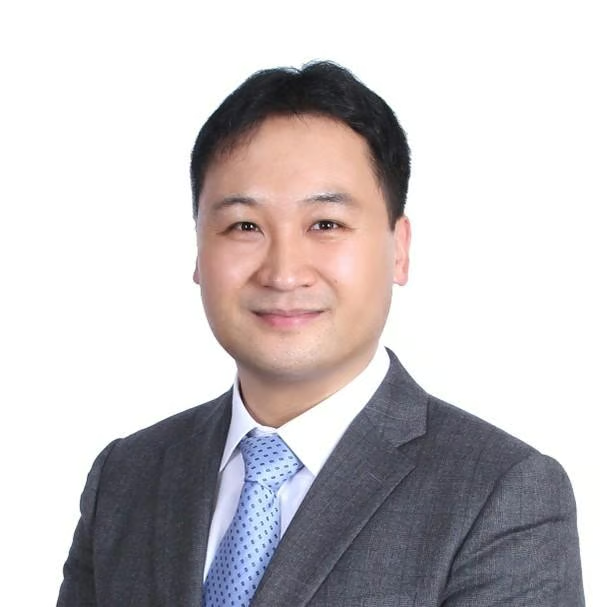
Myung-Ki Kim
Korea University
Invited Talk in: Nanophotonics
Scalable Heterogeneous Integration for Next-Generation Nanophotonics
This presentation introduces recent advances in transfer-integrated nanolaser platforms for next-generation silicon photonics and co-packaged optics (CPO). Starting from planar heterogeneous integration of III–V nanolasers onto silicon waveguides, scalable transfer-printing strategies for ultra-compact on-chip light sources will be discussed. Particular emphasis will be placed on rolling-enabled non-planar integration, which introduces mechanical orientation as a new degree of freedom for polarization-selective coupling and expanded device functionality. In addition, minimal-gain printed silicon nanolasers enabling continuous-wave operation and three-dimensionally programmable nanolaser arrays around optical fibers will be presented, demonstrating how transfer integration can extend nanophotonic systems beyond the limitations of conventional monolithic fabrication.
Myung-Ki Kim is a Professor at the KU-KIST Graduate School of Converging Science and Technology, Korea University, Republic of Korea. He received his Ph.D. in Physics from KAIST in 2009 and conducted postdoctoral research at the University of California, Berkeley and the California Institute of Technology. His research focuses on silicon photonics, heterogeneous nanophotonic integration, transfer-printed nanolasers, metasurfaces, and advanced photonic materials. His group develops scalable photonic platforms for optical interconnects, co-packaged optics, and integrated quantum and nanophotonic systems, bridging nanophotonics, semiconductor device engineering, and advanced materials science.

Chang-Seok Kim
Pusan National University
Invited Talk in: Frontiers in Optical Metrology
Advances in 3D OCT Metrology using Wavelength-Swept Lasers
Optical coherence tomography (OCT) is a non-invasive imaging modality capable of providing high-resolution, three-dimensional visualization for both biomedical and metrological applications. Compared to classical time-domain OCT (TD-OCT), swept-source OCT (SS-OCT) offers faster imaging speeds and a better signal-to-noise ratio due to advancements in wavelength-swept laser (WSL) light sources. The performance and application range of a WSL are primarily determined by the laser’s linewidth, tuning range, linearity, and repetition rate. This presentation reviews the development and current status of WSL light sources and their imaging applications, with a focus on achieving higher speeds and improved precision in 3D metrology.
Chang-Seok Kim obtained his Ph.D. in 2004 from the Department of Electrical and Computer Engineering, Johns Hopkins University, USA, for research in the area of biomedical imaging and fiber laser systems, after finishing his Master's degree in 1999 from Gwangju Institute of Science and Technology (GIST) and his Bachelor degree in 1996 from Korea Advanced Institute of Science and Technology (KAIST), Korea. Subsequently, he held a postdoctoral fellowship at the Beckman Laser Institute and Medical Clinic, University of California at Irvine, USA, for research in the area of biophotonics and biomedical sensing. He returned to the Department of Optics and Mechatronics Engineering, Pusan National University, Korea as a faculty member in 2005 and is now a Professor.
His early research covered specialty fiber design/fabrication and fiber lasers. Following his initial wide experience with fundamentals in fiber optics, his research interests have moved to applications of wavelength-tunable fiber laser. Nowadays, his research has diverged to the practical system for 3D biomedical and metrological imaging applications based on wavelength-tunable fiber lasers, such as optical coherence tomography (OCT) imaging, photo-acoustic tomography (PAT) imaging, and FMCW (frequency modulated continuous wave) light and detection and ranging (LIDAR) imaging. His work has led to over 180 SCI journal publications and 50 registered patents.

Min Yong Jeon
Chungnam National University
Invited Talk in: Applications of Optics and Photonics
Advances in Optical Fiber Sensing Systems Based on Wavelength-Swept Lasers
Recent advances in optical fiber sensing systems based on wavelength-swept lasers (WSLs) are presented. An ultra-wideband WSL with a scanning bandwidth exceeding 440 nm enables one-to-one mapping between spectral and temporal domains, allowing real-time interrogation without complex signal processing. This approach is applied to strain sensing using cholesteric liquid crystal elastomers and to volatile organic compound detection using porous cholesteric liquid crystal films integrated on fiber ferrules. The results demonstrate high sensitivity, fast response, and stable operation, indicating the suitability of WSL-based systems for practical real-time optical sensing applications.
Min Yong Jeon received the B.S. degree in physics from Hanyang University, Seoul, Republic of Korea, in 1988, and the M.S. and Ph.D. degrees in physics from the Korea Advanced Institute of Science and Technology (KAIST), Daejeon, in 1990 and 1994, respectively.
He has been a Professor with the Department of Physics, Chungnam National University, Daejeon, Republic of Korea, since 2003. Prior to this, he was a Research Scientist at the University of California, Davis, CA, USA, where he worked on optical routers. From 1994 to 2001, he was with the Electronics and Telecommunications Research Institute (ETRI), Daejeon, Republic of Korea, where he conducted research on optical network subsystems. His current research interests include mode-locked fiber lasers, wavelength-swept lasers, optical fiber sensors, and optical terahertz wave generation. He is a member of SPIE, IEEE, and the Korean Physical Society (KPS), and a Senior Member of Optica and OSK.